A two-compartment outdoor telecom cabinet splits its battery compartment from the equipment compartment on the right by a partition. The battery compartment is built to hold storage batteries, and its thermal shell combines insulation cotton on the outer panels, a sunshade cover, and a small ventilation device, with a semiconductor (Peltier) cooling unit reserved for the battery side. That same cooling method is explicitly not available for roadside-type cabinets, so understanding when the battery compartment is actively cooled and when it relies on the shell alone is the first decision in the design review.
The two compartments share one envelope, but they hold equipment with different thermal behavior. Rectifiers, transmission units and switching gear generate heat continuously and need airflow; batteries sit idle most of the time and are harmed by sustained heat rather than by their own losses. Treating the battery compartment as a passive room inside the cabinet, rather than a second equipment bay, is what keeps the enclosure design coherent.
How the two compartments are separated
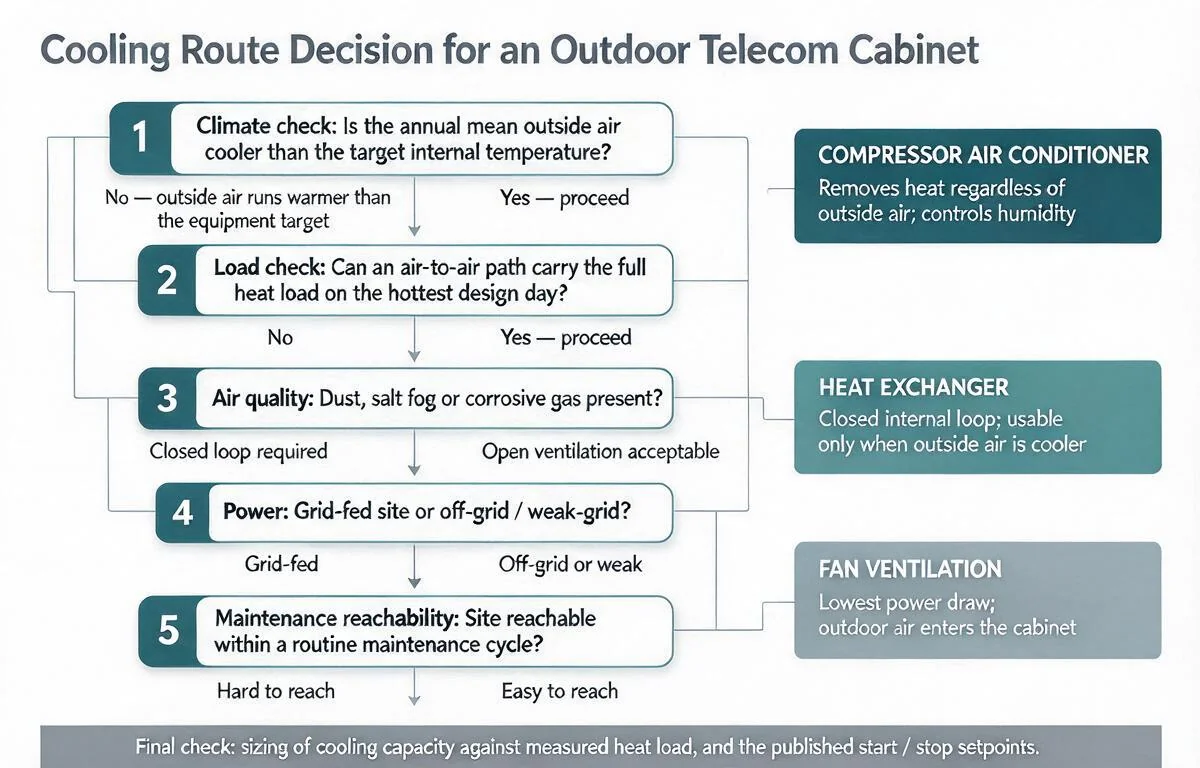
Across the cabinet, the equipment compartment occupies the right side and a partition separates it from the battery compartment, so the two spaces insulate each other. From the equipment side, the partition keeps battery-compartment conditions out of the equipment air path and the other way round. Equipment ventilation and heat exchanger options apply to the equipment compartment alone, so air used to cool rectifiers and switches is not drawn through the battery bay.
The partition closes a thermal loop with the compartment cooling choice. A refrigerated battery compartment stays sealed off from warm equipment exhaust, and a battery side that relies on shell insulation plus a shading cover needs the same separation, so the equipment fan path does not turn the partition into a heat transfer surface. Sizing an equipment heat exchanger or fan therefore starts with the partition: it is the boundary that decides whether the battery bay sits inside or outside that airflow.
Insulation, sunshade and gas venting
Insulation cotton on the outer panels
Thermal insulation cotton is attached to the outer panels of the cabinet to provide insulation. The intent is to blunt the daily heat wave moving through a metal skin hit by direct sun, and to slow heat loss at night and in cold snaps. Insulation thickness and the values a thermal model needs are project inputs: take them from the approved cabinet specification, so the numbers you calculate rest on the construction actually supplied.
Where the insulation meets the structure matters as much as its presence. Joints at the door frame, cable entry and partition edge are the usual thermal bridges in a two-bay cabinet, and a full panel of cotton behind an unsealed gland will not deliver what the model assumes. Cable entries in this cabinet are kept independent, with separate holes for power, signal and optical cable, which also cuts the number of unsealed openings a designer has to reason about.
The sunshade cover
An additional sunshade cover over the battery compartment provides sun protection and waterproofing. A roof overhang does two things at once here: it removes direct insolation from the battery-side panels during the hottest hours, and it keeps rain off the upper seams, vents and door edges. Both effects reduce the heat load the insulation and any cooling device must handle, and a wet enclosure edge is the classic starting point for water reaching the battery area.
Shading is the least invasive thermal measure in a site-bound cabinet because it changes nothing inside. It also shifts the hour at which the battery compartment peaks, and a west-facing site that takes late-afternoon sun shifts more than most. That timing matters when measured temperatures are set against the equipment load profile.
The ventilation device for battery gases
A ventilation device on the cabinet releases gases produced by the storage batteries during charging. Its purpose is gas management, not cooling. The battery compartment's thermal behavior is handled by the insulated shell, the shade and, where configured, semiconductor refrigeration; the vent exists so that vented battery chemistry can breathe inside a sealed enclosure.
The vent's position relative to the battery rack, the door seal and the sunshade decides whether it works. An outlet under a sunshade edge still lets gas out; one crowded against the shade's fixing or a cable tray does not. Confirm where the vent discharges and that the shade frame, cable routing or a later site fence cannot obstruct it.
Semiconductor refrigeration for the battery compartment
The battery compartment of this outdoor integrated cabinet uses semiconductor refrigeration, a solid-state Peltier cooling method rather than a compressor-based one. Beyond that, the module arrangement, its heat-rejection surfaces and its electrical connection were not supplied with the product data used here, so take them from the approved project configuration and specification drawing before you fix openings, service clearance or power connections.
Cooling capacity, the target compartment temperature and the unit designation belong to the project configuration, and those figures are what a sizing calculation needs from the approved specification. One more property of the cooling path matters: the module runs on the site supply, so cooling runtime is an operating cost carried by the station supply rather than by the battery.
Why roadside-type cabinets are excluded
Semiconductor refrigeration is not available for roadside-type cabinets. The exclusion comes from a product description of the outdoor integrated cabinet we make, not a general statement about every outdoor enclosure, and it is best settled at the start of a project rather than discovered at the end of the bill of materials.
Two conditions on a roadside site help explain why the option is withheld:
- Service access. A Peltier unit concentrates heat on a finned exterior surface, and that surface and its fans need cleaning while its connectors need servicing. A cabinet maintained from a footpath or a traffic lane offers a limited safe working window, where such recurring work is hard to schedule and easy to skip. A neglected heat-rejection surface then cuts cooling in the season it is most needed.
- Heat-rejection path. The module rejects heat into local ambient air. A roadside cabinet often sits close to the ground, the kerb or a wall, and adjacent surfaces can radiate heat back into the inlet. Where clearance around the hot side cannot be guaranteed, the unit's useful output cannot be promised.
Both arguments are engineering judgment about maintenance and heat rejection, not measured performance data. If a roadside project truly needs an actively cooled battery compartment, the decision needs a site-specific review of service access and clearance, and it should not be settled by copying the specification from a non-roadside cabinet.
Monitoring closes the loop on the thermal design
A compartment design is finished on paper long before it is proven on site, so the alarm set is what turns the drawing into something the operator can act on. Each door carries a door-open alarm sensor wired to the cabinet's environmental monitoring, and the cabinet's power and environmental monitoring functions can upload alarms for power failure, power fault, access control, temperature, humidity, smoke, water immersion and battery voltage. Alarm thresholds and response times are project settings, so agree both with the monitoring owner at commissioning.
The alarm list maps to failure modes rather than to a feature count. Temperature and humidity cover the thermal and moisture path the partition and insulation are meant to control; power failure and power fault show whether the cooling unit and the alarm system still have supply. Battery voltage is the one signal that reports the battery's own condition. Smoke and water immersion sit at the safety end, and water immersion says the most about a shaded compartment, because it can be the first sign that rain is getting past a seam beneath the sunshade.
Monitoring channels and the failure each one reveals
| Thermal element | What can go wrong | Signal that reveals it |
|---|---|---|
| Insulation cotton on outer panels | Compromised panel or thermal bridge at a seam | Temperature and humidity trend against outdoor conditions |
| Sunshade cover | Seam or fixing allows water past the shade | Water immersion alarm; door-seal condition at inspection |
| Partition between compartments | Equipment exhaust reaches the battery side | Temperature and humidity alarms; zoned sensing in both compartments, if included in the project |
| Ventilation device | Obstructed outlet after shade or cable work | Door-open records point to the work that may have disturbed it; the outlet itself is checked manually |
| Semiconductor refrigeration | Loss of supply, or reduced heat rejection at the module | Power failure and power fault alarms; raised compartment temperature |
| Battery rack | Cell degradation or a failing block | Battery voltage alarm |
The temperature and humidity alarms in the table report through the cabinet's monitoring system. Comparing the two compartments directly needs a temperature sensor in each, which is a project-level addition rather than a standard channel. Because the door-open sensor is wired to the same environmental monitoring, a service visit that leaves a door seal or a shade fixing disturbed shows up as an access event. Matching that record to a later temperature or water alarm is often enough to find the cause without a second trip. Each cabinet also has a DC -48V lighting fixture, so diagnosis at night or during a supply outage does not depend on external light.
Temperature and lead-acid service life
Battery life is the reason the compartment has a thermal design at all: lead-acid ageing is strongly temperature-dependent, and a higher battery temperature accelerates it. A hot outdoor enclosure therefore shortens standby life even when the battery is barely discharged.
A third-party industry article on lead-acid batteries in telecom base stations, not our test data, puts typical life at roughly 6-7 years indoors at around 25 C and around 2-3 years for outdoor installations exposed to high temperatures. This is a sector-level observation, not a controlled comparison, and the outdoor cases span several enclosure designs. Read it as a direction of effect: an outdoor site without a thermal strategy gives up years of standby life, while lowering the daytime peak of the battery compartment recovers part of that gap.
The figures work as a benchmark for weighing design options between sites. They are not a service-life claim for this cabinet or for the batteries installed in it, and we do not publish a battery life figure by model. Every life claim calls for the same questions: at what temperature, in what enclosure, under what charging regime.
Design review checklist
Work through the items in order, since each one changes the assumptions of the next. Most of the questions can be answered from drawings and from the enclosure description before any equipment is ordered.
- Separate and prioritise the two compartments. Confirm the equipment compartment on the right, the partition to the battery compartment, and that equipment airflow, including any heat exchanger option, stops at that partition.
- Agree the thermal target with the battery supplier. Fix the charging temperature window the battery chemistry allows, and the ambient peak at which the shell alone would exceed it.
- Confirm the shell measures for this specific compartment. Insulation cotton on the outer panels, the sunshade over the battery side and the partition are all present; take thickness and insulation values from the approved cabinet specification for any thermal model.
- Fix the vent's location and discharge direction. Confirm the gas outlet cannot be blocked by the shade fixings, cable trays or a new fence installed after commissioning.
- Check the cabinet type before specifying Peltier cooling. Semiconductor refrigeration applies to the battery compartment of this integrated cabinet and is not available for roadside-type cabinets; any exception needs a written site review of service access and heat-rejection clearance.
- Write down the alarm thresholds. Temperature, humidity, power failure, power fault, battery voltage, smoke and water immersion all feed the monitoring system; the alert levels, the recipients and the response path have to be agreed in the project, not assumed.
- Plan the access routine. Include cleaning the cooling unit's exterior surfaces, checking that the battery gas outlet is clear after any shade or cable work, inspecting the door seal and the shade, and recording door-open events against later alarms.
Constraints such as a footpath installation, a shaded court, an unusually hot region or a supply that limits cooling runtime change the thermal design rather than merely scale it. Those constraints lead any sizing or configuration review: send the cabinet type, the battery chemistry and the site's ambient extreme, and the compartment configuration can be matched to the site instead of guessed from a datasheet.
Background on the compartment components is described in our article on the components and advantages of outdoor integrated cabinets. Cooling options for the equipment side, and how they differ from the battery compartment, are covered in the guide to choosing cooling for an outdoor telecom cabinet. The general technical parameters of these cabinets are listed in the overview of outdoor integrated cabinet advantages and parameters.
——END——