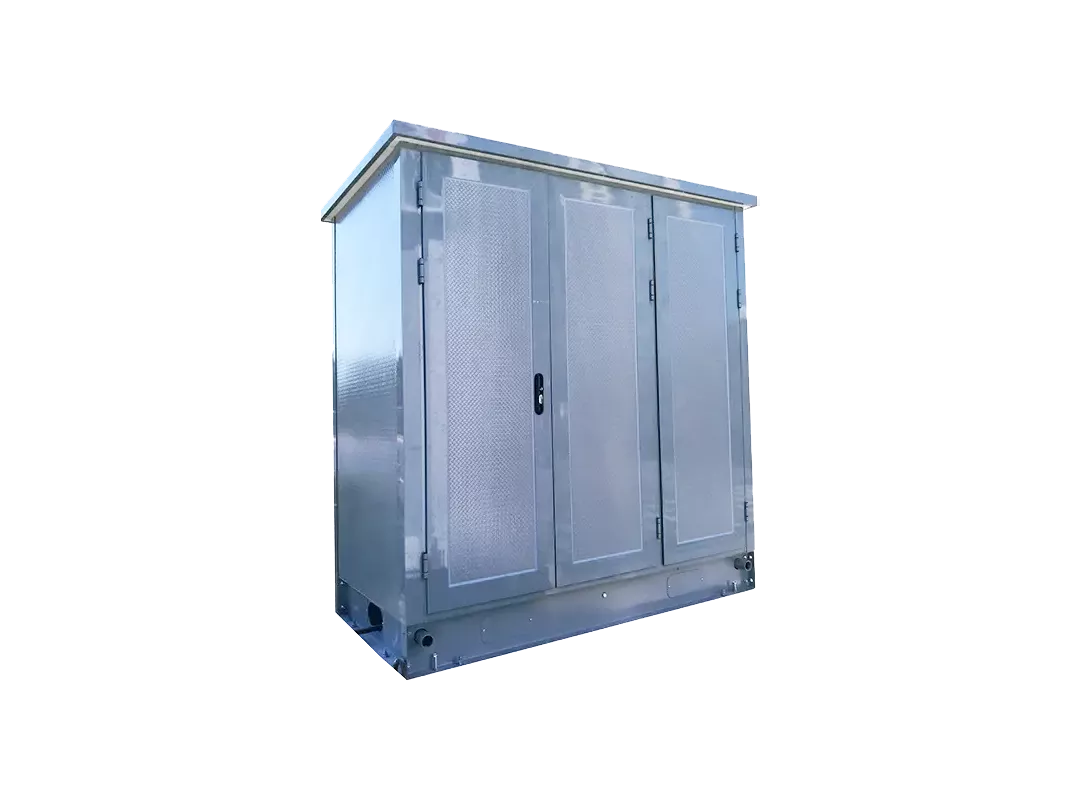
An underground smart cabinet puts a working telecom node below a street surface that has no free footprint left. The decision is not simply "below ground instead of above ground." It turns on two testable questions: what the IP68 statement actually covers for that enclosure, and whether crews can restore service without climbing into the cavity.
The Intelligent Buried Cabinet is specified for that position. The manufacturer states its protection level as IP68 against GB4208-1993, and the cabinet is designed to protect the communication equipment inside from the climate of its buried position. It can integrate a communication power supply, BBU equipment, temperature control, water immersion detection and monitoring as separate modules, and each module can be replaced independently when it fails.
Where a buried node earns its place
The site types where the cabinet is specified are city streets and main roads, residential and commercial districts, and underground parking lots. Read those together and a pattern appears: each is a location where an above-ground footprint competes with something that has a stronger claim on it — a walkway, a sightline, a turning radius, a parking bay. Constrained surface space is the reason, not traffic volume.
That reframes what the project team is buying. A buried cabinet is not a cheaper cabinet; it is an enclosure whose cost includes the civil element of putting it below grade and whose benefit is released above grade. Municipal and operator teams usually have a defensible case when they can name the specific right-of-way constraint being relieved and the specific node function that must stay close to it — a micro base station position on a main road, a fibre aggregation point serving a dense residential block, a distribution node inside a parking structure.
The reverse case is just as clear. Where surface space is available and a foundation is easy, a conventional outdoor cabinet serves the same electrical function with less site work and simpler access, and this product's advantages do not apply. In a crowded city the interesting engineering question is not whether buried beats above-ground; it is which nodes in the project have to go underground and which can stay up. Mixing the two per node is normal, and with this cabinet it is workable — modularity, flexible expansion and simple installation are stated properties, so a buried cross-connect node and the above-ground cabinets around it can come from the same product family and share the same spares.
Reading IP68 as a test condition, not a slogan
The stated protection level for this cabinet is IP68, with all technical performance indicators stated as complying with GB4208-1993.
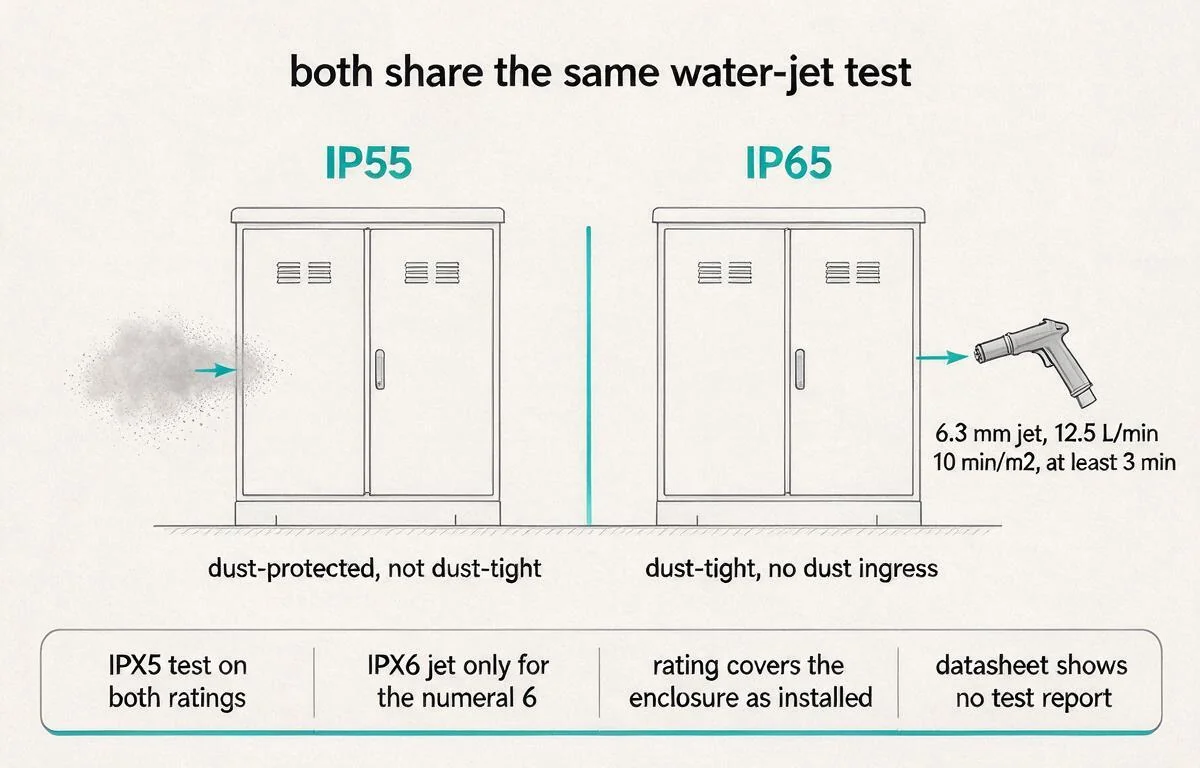
The two digits carry different information. The first numeral rates protection against solid objects, and at 6 the criterion is no ingress of dust. The second numeral rates protection against liquids, and 8 is the highest level on that scale. Both scale positions come from the IP code itself, whose definitions are published in IEC 60529 for electrical equipment with a rated voltage not exceeding 72.5 kV.
Digit 8 is where buyers most often misread a specification. IEC 60529 does not impose one fixed immersion routine the way it does for the lower liquid digits. The test conditions are agreed between manufacturer and user, subject to two requirements: they must be more severe than those prescribed for IPX7, and they must take into account that the enclosure will be continuously immersed in actual use. Depth, duration, orientation and liquid condition are therefore part of the agreed programme, and a proper test report records them. IEC's own IP ratings overview makes the same point from the other direction: the rating scale is public, the testing conditions live in the standard, not in the marketing number.
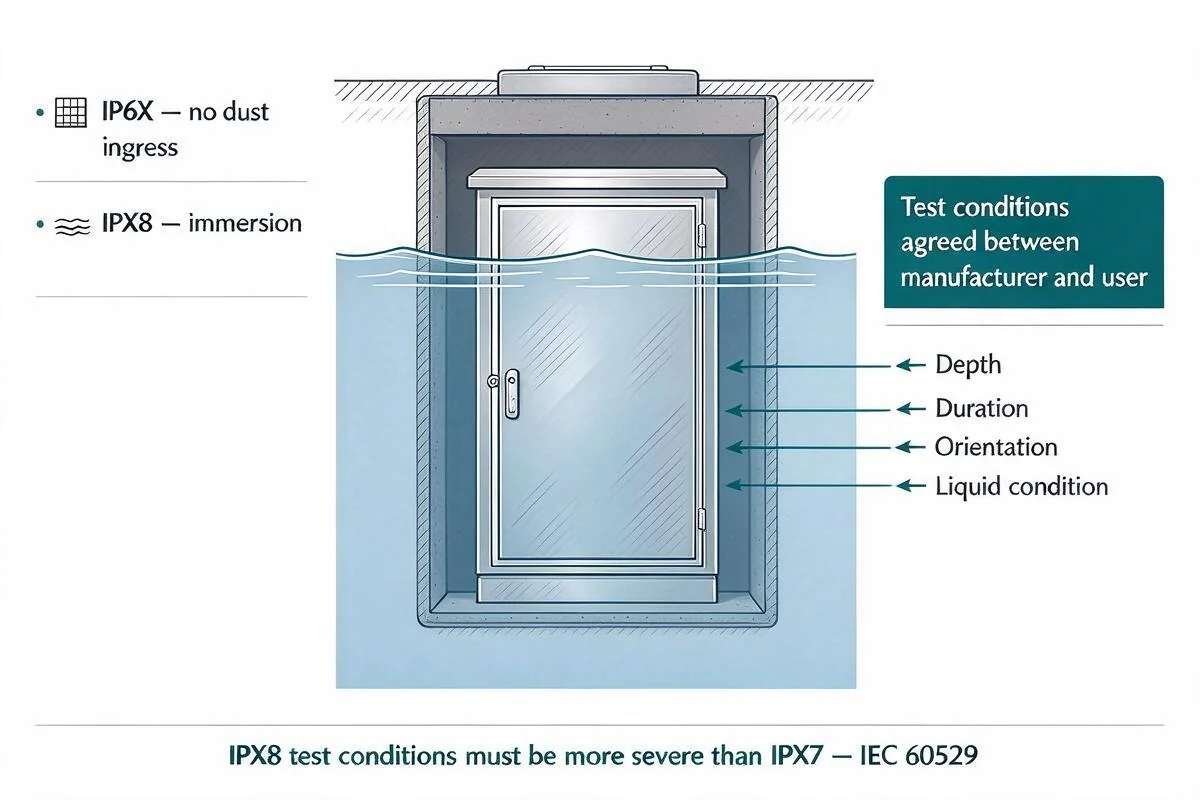
That has a practical consequence for anyone specifying a buried node. "IP68" answers the dust question fully and the water question only partly, because it does not tell you the immersion envelope the enclosure was qualified to. The number that matters for a street cabinet is the agreed depth and duration, matched to the water table, the drainage behaviour of the pit, and how long standing water could realistically remain after a storm. Those are project inputs. A proposal that states IP68 without them leaves the comparison incomplete, and two IP68 cabinets with different agreed envelopes are not the same product for your site.
The standard edition is the second thing to check. GB 4208-1993 is the Chinese degrees-of-protection standard this cabinet's rating is stated against, and it has been revised: the catalogue record for GB 4208-1993 shows its document history pointing to GB/T 4208-2008 as the revision. That does not invalidate a rating stated against the 1993 edition. It does make the edition worth pinning down in the paperwork: the edition named in a quotation should match the edition your acceptance documents reference, so the test conditions and the report behind the rating can be compared like for like without a discussion at inspection.
What the cabinet keeps out of the enclosure environment
The body is 304 brushed stainless steel plate, specified for mechanical strength, corrosion resistance and weather resistance. That material choice does specific work in a buried position: a pit is a damp, occasionally waterlogged, chemically variable environment, and the shell is the only continuous barrier between that and the electronics.
Access hardware is fitted rather than improvised — integral hinges, buckle locks and stainless steel clamps, with the stated aim of resisting theft and keeping foreign objects out of the lock cylinder. Treat those as the closure design they are described as. No burglary-resistance standard, forced-entry test or security certification accompanies them, so they support a claim about construction and lock protection, not a rating a project can cite against an attack class.
The printed environment limits describe the range the assembly is specified for: operating temperature -40 °C to +60 °C, storage temperature -40 °C to +60 °C, relative humidity 95% or less at +40 °C, and atmospheric pressure 70 kPa to 106 kPa. Note the pairing on the humidity figure. It is a limit at a stated temperature, not a blanket 95% allowance at any temperature, and a commissioning record that logs humidity without logging the temperature alongside it is not checking that line.
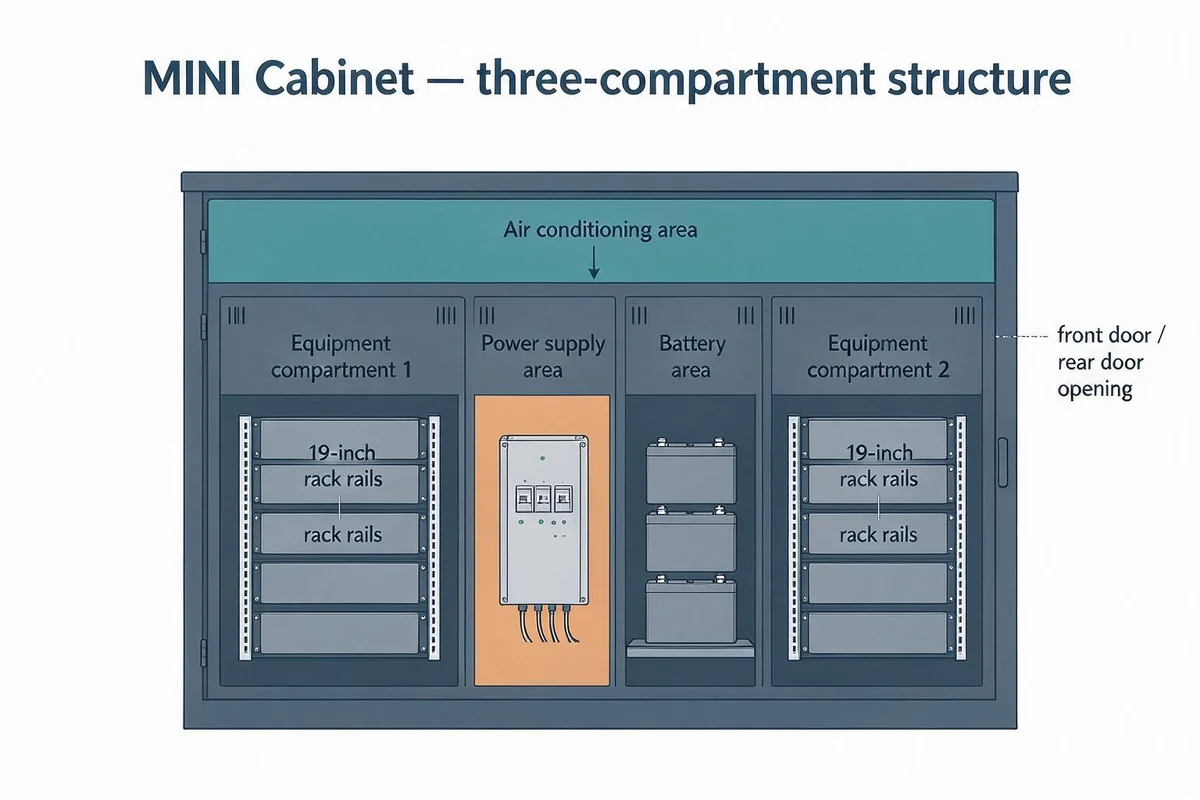
Inside that shell sits a larger thermal question. Sitting below grade removes the assembly from direct solar load, and soil thermal behaviour also varies with depth, moisture and the pavement above the pit — an input judged for each site rather than a fixed property of the enclosure. The cabinet integrates a temperature control module, and the internal space is partitioned by temperature logic, so equipment with different thermal tolerance can be grouped into zones that are conditioned differently. What that zoning achieves depends on the installed module and its settings.
Electrical safety provisions and what each one covers
Two electrical figures on this cabinet are documented with their test conditions, which is how they should be read:
| Property | Stated value and test condition | What it lets the project check |
|---|---|---|
| Insulation resistance, high-voltage protection ground to cabinet | Greater than 1000 MΩ at 500 V DC | A megohmmeter reading at the specified test voltage, taken between those two points |
| Withstand voltage, high-voltage protection ground to cabinet | Greater than 3000 V DC for 1 minute, no breakdown or flashover | A dielectric test at that voltage and duration, on that same pair of points |
| Grounding protection | Reliable and complete grounding provision, as stated | That grounding is provided; not a lightning or surge rating |
Both measured values are DC tests between the high-voltage protection ground and the cabinet, and both are stated as a floor rather than a nominal figure. A site acceptance sheet that reproduces the same voltage, duration and measurement points will reconcile against the specification; one that tests at a different voltage, applies AC, or measures between different terminals produces a number that cannot be compared to it.
Grounding is the provision that ties this together in a wet location. The cabinet is stated to have reliable and complete grounding protection. That statement is about the provision and stops there: nothing in the specification extends to a lightning protection level, a surge current rating or an earthing resistance target for the pit. Where the project needs those, they belong to the site's electrical design and its acceptance criteria, written as such rather than assumed from the enclosure.
Service access without entering the cavity
Maintenance without entry is the design property that changes how this product is operated, and it rests on three things the specification states together: every integrated module can be replaced independently when it fails, cable entry, jumper connection and termination work are all performed from the front, and the tray can be constructed independently with splicing and termination separated while operated on the same level.
Put those side by side and the routine becomes legible. A crew opens the surface closure, works from the front at the module or tray that has failed, swaps that unit, and closes up. The rest of the cabinet — power, BBU, the other modules — stays in place and stays connected. A single module failure does not imply internal rewiring, and the fibres already terminated on the tray are not disturbed by work in a separate zone.
The value sits in the two failure classes that would otherwise force extended downtime. Power and BBU modules carry the electrical function; temperature control and water immersion modules carry the protection function. Because they are independent units, a failed temperature control module and a failed power module produce two localised jobs rather than one cabinet-level replacement.
Two conditions belong next to that routine rather than in a separate section. First, module replacement is an electrical intervention: on a powered cabinet it follows the project's isolation and verification procedure before any module is pulled, and the module's own instructions govern. Second, "without entry" describes the maintenance method, not a guarantee that the cavity is never entered. Installation, first commissioning, civil inspection and any work on the below-grade structure are different tasks with their own arrangements. Treating the no-entry routine as the whole of the O&M plan is the mistake this section is meant to prevent.
What the monitoring modules change about response time
Temperature control, water immersion detection and remote monitoring are fitted functions of this cabinet. What they alter is the shape of the response: a fault the monitoring function reports arrives as a notification rather than as a discovery made on a scheduled walk-by. That is the mechanism behind the stated design aim of reducing the need for workers to enter confined spaces — the crew is dispatched with a known fault rather than sent to find one.
The specification describes the functions and not their behaviour. No sensor threshold, alarm setpoint, reporting interval, protocol or platform integration is stated for these modules, so a project that needs an alarm at a specific water level, or a particular northbound interface into an existing element manager, cannot settle that from the enclosure description. Those belong in the module configuration agreed at order and vary with what is installed.
For a buried node this is the part of the O&M method that most repays thinking through before the pit is built, because it determines who sees a wet pit first. A monitoring function that reports into the operator's existing process, with a named owner and a defined action, is worth more in a storm than a capable sensor reporting into a system nobody is watching.
Transport, hoisting and the temperature-logic partition
The cabinet supports overall transportation and hoisting. That is a delivery and placement property: the assembly is moved and set as a unit rather than built up in the pit. It is worth distinguishing from the site's own lifting plan, which belongs to the contractor and depends on the loaded weight, the lifting points, the pit geometry and the access the street allows — none of which this enclosure description supplies.
The temperature-logic partition is the other installation-adjacent property, and it explains why the interior need not be treated as one thermal zone. Equipment that tolerates a wider range can share a zone with equipment needing tighter control only if the installed temperature control module is set up to deliver that, so the partition and the module configuration are read together.
If you are putting buried nodes into a street or a parking structure, the conversation worth having early concerns at least two inputs this enclosure description cannot supply: the immersion envelope your site actually needs, and the module configuration for the monitoring functions. The buried products range lists both cabinets with their parameter tables, and HJ Group's technical team can work through a project's site conditions against them.
——END——